A 165-year-old mystery surrounding the death of Queensland’s first police officer to die in the line of duty may finally be closer to being solved, thanks to a passion project spanning years of research, local history and painstaking detective work.
On a wet August day in 1861, Constable Matthew Connolly set out on horseback carrying medicine for two gravely ill women. He never made it home.
Over a century and a half later, a Queensland Police Service chaplain has spent years retracing the officer’s final journey, piecing together old records, maps and local history to identify the place where Connolly is believed to have made his final attempt to cross a flooded creek.
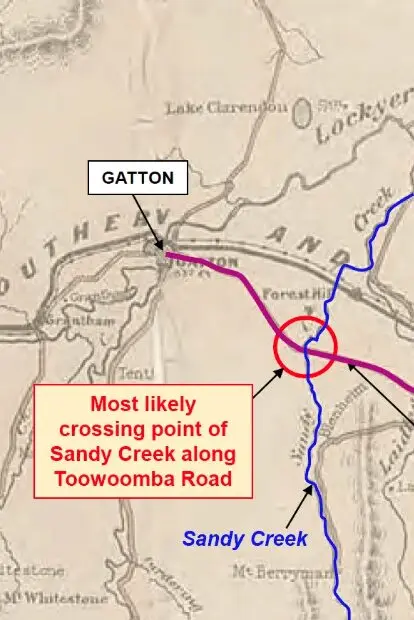
The search has now identified a site at Sandy Creek near Glen Cairn as the most likely location where Queensland’s first police officer to die in the line of duty lost his life.
But the search for Connolly’s story is not over.
There are hopes of locating his grave in Ipswich, establishing a permanent marker at the site of his death and, perhaps, finding the one piece of his story that has remained elusive for more than a century and a half – a photograph of the officer himself.
Constable Connolly’s story began long before his final journey
Born inGalway, Ireland in 1817, Constable Connolly migrated with his wife and family to Australia in 1853.
He joined the mounted police in New South Wales before becoming a police constable in B Division of the Metropolitan Police Force. He was later transferred to Ipswich as a mounted officer, where he remained for several years before being transferred to Gatton as a Watchhouse Keeper sometime before 1860.
It was there, in the early days of policing in Queensland, that Constable Connolly would make the journey that ultimately cost him his life.
On August 25, 1861, Connolly travelled to Ipswich after transporting a prisoner. Before beginning his return journey to Gatton, he was asked by a local doctor to take urgently needed medicine back to the district.
The medicine was destined for two seriously ill women – one for Lady Joshua Bell wife of politician Sir Joshua Bell and the other for the wife of his Officer in Charge Mrs Jackson Curry.
By the time Connolly began his journey home on 29 August, heavy rain had caused creeks and waterways in the area to rise significantly.
The safest option would have been to wait for the floodwaters to recede. But Connolly knew two gravely ill women were waiting for the medicine, so he pressed on.
At Sandy Creek, near Laidley, Connolly reached a crossing that would ordinarily have been used by travellers along the road. The creek was running dangerously high and fast, but Connolly attempted to make the crossing on horseback.
As he entered the flooded water, his horse lost its footing. The pair became separated, and Connolly disappeared into the floodwaters.
He would not return home. His body was located downstream the following day.
Remarkably, the medicine Connolly had been carrying survived the crossing and was recovered intact – meaning the constable had ultimately succeeded in delivering the medication to the sick women, despite losing his own life in the attempt.
More than 165 years later, the circumstances of Connolly’s death have become the focus of another journey – this time, to find the exact place where it happened.
Queensland Police Service Southern Region Chaplain Jeff Baills first became interested in Connolly’s story after learning that the first police officer to die in the line of duty in Queensland had been buried in Ipswich, but that the exact location where he died had never been definitively established.
What began as a question became a passion project spanning more than two years.
“It started with the realisation that the first police officer to die in the line of duty was in Southern Region, and I wanted to know where he died,” Chaplain Baills said.
“I thought we honour many things, so we have to honour Connolly, and we have to know where he died.”
Chaplain Baills began searching through historical records and contacting people who could help piece together the story, including the Queensland and New South Wales Police Museums, Ipswich City Council and local historians.
“I reached out to our local people, and they pointed me to the Laidley Historical Society who were a wealth of working knowledge and assistance and their appreciation of local history was quite exceptional.”
Old maps, police records, newspaper reports and historical accounts were examined and compared, with the research eventually extending to specialist assistance from the Queensland Police Service Geospatial Unit.
The research has now led to a likely location
Following extensive research and assessment, the site at the intersection of Sandy Creek and Glen Cairn Road – formerly the Old Toowoomba Road at Glen Cairn – has been assessed as the most likely location where Constable Connolly attempted to cross the creek in 1861 (map pictured below).
For Chaplain Baills, reaching that point has required patience and a willingness to follow the evidence wherever it led.
“It was a collective effort of generosity of time,” he said.
“We overlaid all the different pieces of information and got to the point where this points to this, which points to this, and confirms what we believe is the exact place of his passing.”
He said it was important the location was established through evidence rather than assumption.
“You have to remove your bias and opinion when you do this and just go with the facts,” he said.
“You want history to speak for history; you don’t want to overlay it.”
A family connection
For Connolly’s descendants, the discovery has also brought a sense of connection to a story that has been passed down through generations.
His great-great-granddaughter, 87-year-old Juanita Keegan (pictured with Chaplain Baills), began researching her ancestor’s life in her 70s after first hearing his story from a family member.
What began as an effort to learn more about her great-great-grandfather has continued for years, and she said she was grateful to the QPS and everyone who had taken up the search alongside her.
“I am very thankful to the Queensland Police Service and everyone who has been involved in this,” Ms Keegan said.
“It means a lot to know that people have taken up the cause and have put so much time and effort into finding answers about what happened to Matthew.”
When told the location where her great-great-grandfather is believed to have died had now been identified, Ms Keegan said she was “very happy”.
“For all these years, there have been questions about exactly where he died, so to finally have a likely location is very special,” she said.
The search has also uncovered questions surrounding Connolly’s final resting place.
Historical records indicate his body was taken to Ipswich for burial, however, the exact location of his grave has never been conclusively identified.
“We know which section in the Ipswich General Cemetery he is buried in, however in the 1860’s a huge flood inundated Ipswich washing the records of the time away. Furthermore, sometime in the 1970’s or 80’s someone went in with a tractor and slasher and mowed down all the cast iron plot pegs, so unfortunately all easily accessible info was lost.”
Chaplain Baills is now hoping any remaining historical church and cemetery records, may help to locate Connolly’s grave ensuring the officer has a permanent place of remembrance.
“I think we should exhaust all avenues to try and find Connolly’s actual gravesite,” he said.
“I would like to see him formally honoured.”
He also hopes a marker can eventually be established at the Sandy Creek site, giving police and members of the community a physical place to recognise the sacrifice made by an officer who died while trying to help others.
“I think it would be really good to see a marker placed at the location that gives police and the community somewhere to go and say, ‘This is where Constable Connolly died’,” Chaplain Baills said.
There is one further piece of the story Chaplain Baills hopes can be found – a photograph of Connolly.
Despite years of research, no confirmed photograph of the officer has been located.
“If we could find a photograph of him, that would be the icing on the cake,” he said.
“It would be saved in our QPS records for all time, and we could honour Connolly properly and know that we have honoured the first police officer in Queensland who died in the line of duty.”
For Chaplain Baills, the project is ultimately about more than locating a creek crossing, a grave or a photograph.
It is about making sure a police officer who gave his life trying to help others is remembered.
“What I have learnt through this journey is that Constable Connolly’s actions and commitment to his service reflect the same ‘service about self’ attitude that continues to guide our police officers every day.”
“We should be proud of our police history, and we should be proud of the people who served before us and who have gone before us.”
More than a century and a half after Constable Matthew Connolly rode into the floodwaters of Sandy Creek, the search continues to ensure his story – and his sacrifice – is never lost again.
National Police Remembrance Day
Constable Connolly’s story holds particular significance as police across Queensland prepare to mark National Police Remembrance Day on 29 September.
The annual day provides an opportunity to remember police officers who have lost their lives in the line of duty, while recognising the service, dedication and sacrifice of police officers past and present.
For the Queensland Police Service, the tradition stretches back to Constable Matthew Connolly – the first officer recorded as dying in the line of duty in Queensland.
His name remains on the Queensland Police Service Memorial, where he is remembered more than 165 years after his final journey.
With hour he served.
The Queensland Police Service acknowledges and sincerely thanks Brenda Sear, Ron Johnstone, Cheryl Qualischefski, retired Assistant Commissioner Brett Schafferius, Member for Lockyer Valley Jim McDonald MP, Queensland Police Museum, QPS Geospatial Unit, St Mary’s Church and Ipswich City Council for their time, knowledge and assistance in researching the life, death and final resting place of Constable Matthew Connolly.
Their generosity, local knowledge and commitment to preserving Queensland’s history have been invaluable in helping piece together Constable Connolly’s final journey and honour his memory.